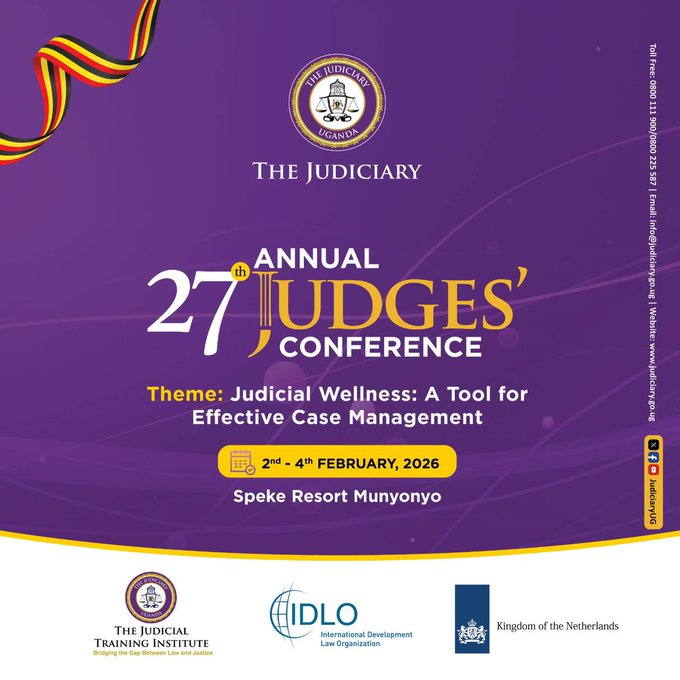

Uganda’s Judiciary is embedding wellness programs into its core strategy to safeguard judicial integrity amid rising caseloads as highlighted at the 27th Annual Judges’ Conference opened by Vice President Jessica Alupo.
Representing President Yoweri Museveni, Alupo kicked off the three-day event at Speke Resort Munyonyo February 02, drawing Justices, Registrars, and justice stakeholders from Uganda and beyond. It is organized by the Judicial Training Institute with support from the International Development Law Organization (IDLO) and the Kingdom of the Netherlands. the conference centers on the theme: “Judicial Wellness: A Tool for Effective Case Management.”

Chief Justice Flavian Zeija’s keynote set the tone, linking officer wellbeing directly to justice quality. “Stressed judges erode public trust,” he warned, citing global data showing over 75% of judicial officers worldwide battle mental and physical strain from heavy workloads and burnout stigma.
Zeija spotlighted international momentum, including the Nauru Declaration and the UN’s July 25 International Day for Judicial Wellbeing, now an annual observance for Uganda’s courts. Locally, the Judiciary is acting fast: new gym facilities at the Supreme Court and Court of Appeal, aerobic sessions at court stations, and confidential professional counseling.
A standout feature is a free medical camp with Mulago National Referral Hospital, providing blood pressure checks, diabetes screenings, BMI evaluations, ultrasounds, liver/kidney tests, and ECGs – all tailored for busy judicial staff.

CJ Zeija Flagging Burnout, Insecurity and Backlogs as Key Threats to Justice Delivery
Tying Wellness to Broader Reforms
These efforts align with Judiciary Strategic Plan VI (2025/26–2029/30), which targets case backlogs, digital upgrades, Alternative Dispute Resolution (ADR) growth, and staff welfare. Early sessions dissected performance at the High Court, Court of Appeal, and Supreme Court, praising ADR and Alternative Justice Systems (AJS) for decongesting dockets and boosting access.
Upcoming talks feature Bar Association and private sector views on ADR in commercial/land disputes, plus insights from Zambia’s Chief Justice Mumba Malila on resilient leadership. The event wraps with strategy workshops to lock in wellness as a mainstay for productivity.
In East Africa, where similar burnout plagues judiciaries amid political and land tensions, Uganda’s model – blending local action with global partnerships – offers a replicable path forward.