
As 2025 closes, Uganda’s construction sector reads like a single national pipeline rather than scattered worksites: AFCON‑linked sports infrastructure, oil‑enabling transport and logistics in the Albertine, Kampala’s road and drainage reset, and private‑sector high‑rise projects redefining the capital’s commercial geometry.
The year’s defining change was not only what was built, but the new logic behind what moved fastest: projects with strategic national value, bankable delivery structures, and contractors with proven capacity.
This feature ranks ten of the most influential project drivers and sector “movers” of 2025 -and explains what their momentum means for 2026. Each entry is linked to publicly reported project facts: scope, timelines, budgets, and the policy and financing forces that made these projects prominent.
Top 10 biggest players & project drivers in Uganda’s construction industry (2025)
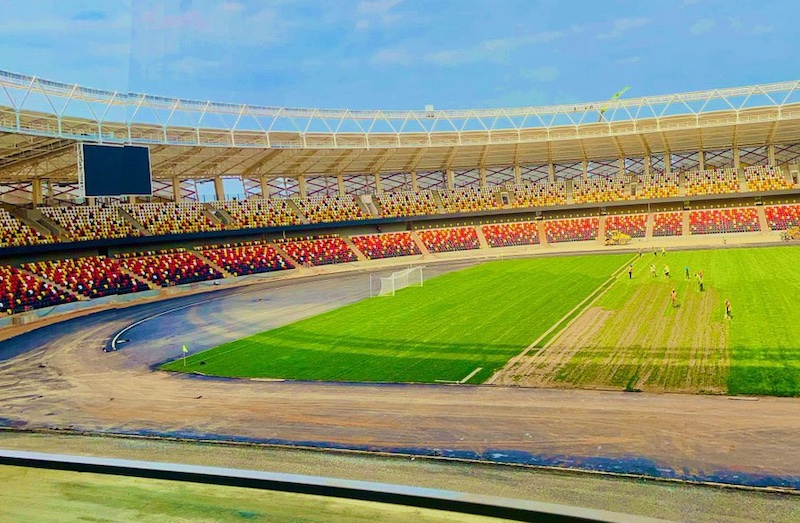
1) Hoima City Stadium (AFCON readiness) — SUMMA (Turkey)
Hoima City Stadium was the country’s most deadline‑driven build of 2025, and its significance goes far beyond sport. The project is part of Uganda’s infrastructure commitments ahead of the 2027 AFCON co‑hosting program.
Public reporting places the stadium at roughly 20,000 seats and links delivery to late‑December 2025, with SUMMA International Construction Company identified as the main contractor.
With a project value widely cited around US$129 million and a cost figure reported in the hundreds of billions of shillings, Hoima became a national benchmark for rapid delivery under international attention.
Equally important is the “cluster effect”: stadium construction accelerated demand for city access improvements, utilities expansion, and hotel and service investment around Hoima as a growing regional node.
2) Kabalega International Airport (Kabaale–Hoima) — SBC Uganda Ltd (SBI + Colas UK JV)
Kabalega International Airport remained one of the most strategically positioned projects in 2025 because it is designed to anchor Albertine logistics, supporting oil‑related movement and long‑term passenger and cargo potential.
Multiple sources in 2025 repeated the handover narrative, pushing completion and commissioning expectations toward September 2025, and identified SBC Uganda Ltd as the contractor, implemented as a joint venture between SBI International Holdings AG and Colas UK.
Project reporting also continued to reference the financing structure for phase one, including external funding support, and the large land footprint reserved for the wider airport development area.
In infrastructure economics, airports are ‘multipliers’: they trigger secondary construction—access roads, warehousing, fuel storage, hospitality, and industrial nodes—which is why this project’s progress is watched closely by contractors and investors alike.
3) EACOP + upstream oil projects (Tilenga/Kingfisher enabling works) — TotalEnergies / partners
Oil‑linked construction was not simply a policy conversation in 2025; it became a physical supply chain.
With EACOP and upstream project programs (notably Tilenga) continuing through construction phases, the sector saw increased activity around camps, pipe yards, water systems, access roads, and industrial‑standard compliance.
Official project communications emphasized progress and local content, while international reporting kept attention on social risk—especially compensation and resettlement issues—which in practice affects schedules, oversight, and documentation standards.
For contractors, the key takeaway is that oil infrastructure raises the bar: it rewards firms that can execute safely, document thoroughly, and manage logistics across dispersed sites.
4) Albertine road packages (oil roads & regional connectivity) — UNRA / Government road ecosystem
Road construction in the Albertine remained a defining civil‑works footprint in 2025 because these are not ordinary roads: they are engineered for heavy industrial traffic, durability, and high utilization.
The strategic story is a package story: corridors that connect oil fields, logistics bases, towns, and border routes.
As these packages mature, they shift from ‘new construction’ into a combination of upgrades, junction improvements, bridgeworks, drainage, and maintenance frameworks—a critical pipeline for 2026 because maintenance is where long‑term contractor presence and predictable cashflow can develop.
5) Kampala City Roads Rehabilitation Project (KCRRP) — KCCA + contractors (incl. Dott Services)
In Kampala, 2025 became a turning point from ‘patchwork fixes’ to an integrated city‑systems approach. KCCA’s KCRRP communications set out a large scope: about 69.70 km of roads, improvement of 22 traffic junctions, around 123 km of non‑motorized transport facilities, commercial parking places, public toilets, markets for vendors along project roads, and installation of 1,600 energy‑efficient streetlights.
KCCA also publicly launched UGX 550 billion works and subsequently pushed contractors to fast‑track delivery. For everyday residents, this is the most visible construction of the year—because road design, drainage, lighting, and walkways change daily mobility and commercial activity. For 2026, the signal is clear: junction performance and flood‑control outcomes will be measured as much as kilometers of tarmac.
6) Sudhir Ruparelia / Ruparelia Group (Meera Investments) — Pearl Business Park & Pearl Tower One
Private‑sector vertical development remained influential in 2025, and Pearl Tower One stood out as a flagship Grade‑A office signal. Multiple reports described a 19‑floor tower with roughly 24,000 sqm of lettable office space and significant parking provision, positioned within the broader Pearl Business Park vision.
This matters because Grade‑A projects pull the whole construction ecosystem upward: façade systems, mechanical‑electrical‑plumbing standards, fire safety, structured parking design, and professional facilities management.
In 2026, expect more competition in the premium office segment—alongside conversions of older buildings—because tenants increasingly demand reliability, power stability, and modern services.
7) Sentongo Haruna — local‑developer momentum and vertical urban projects
2025 also highlighted how locally driven developers are expanding Kampala’s vertical footprint—towers, commercial blocks, and redevelopment concepts tied to densification.
Placed here at number 7 as requested, Sentongo Haruna is presented as part of that broader local‑developer movement: where land scarcity, traffic, and demand for organized retail/office space are pushing developers to build upward and to blend leasing strategy with phased construction.
Public feature coverage around the Wilson Road/Arua Park corridor framed this as a skyline‑level project and an example of locally driven ambition meeting modern urban demand.
8) Hamis Kiggundu — Nakivubo Channel redevelopment proposal (urban engineering + stakeholder complexity)
The Nakivubo Channel redevelopment debate was one of 2025’s most consequential urban‑construction storylines.
Official and parliamentary reporting referenced a presidential directive to support and approve the proposal, and the ensuing oversight debate detailed how such a project could be financed—including the idea that the proponent would finance works, construct property above the drainage corridor, and recoup investment through rental income.
Regardless of opinion, the engineering scale is real: drainage management, environmental controls, structural decking, and high‑risk construction sequencing in a live city corridor. For 2026, the signal is that Kampala’s next construction frontier is not just buildings, but integrated urban systems where engineering, policy, and public accountability collide.

9) Godfrey Kirumira — CBD redevelopment and commercial property influence
Kampala’s Central Business District construction in 2025 increasingly favored organized, well‑capitalized actors.
CBD projects face tough constraints: deep foundations, traffic staging, underground services, and compliance. Kirumira’s prominence in Kampala’s property ecosystem, including formal engagement as a landlord representative in national-level dialogue, reflects how CBD stakeholders increasingly influence both redevelopment direction and the stability of commercial space.
The broader trend—documented in 2025 reporting on Kampala’s construction boom—is that downtown buildings are becoming more technical (HVAC, lifts, logistics docks, energy efficiency), requiring stronger engineering management and more disciplined delivery models.
10) Standard Gauge Railway (SGR) direction — Yapi Merkezi + Government project pipeline
Rail re‑entered Uganda’s long‑horizon construction story as procurement and preliminary activities continued.
Reporting has linked Uganda’s SGR contracting direction to Yapi Merkezi, and 2025 coverage described survey activity and expectations that heavier construction would ramp into 2026. Even when full works are staged, SGR is a ‘construction multiplier’: it unlocks demand for bridges, stations, freight terminals, materials supply chains, and industrial parks.
For 2026, the practical signal is corridor protection, land acquisition progress, and early contractor mobilization—where the groundwork is laid for heavy works to follow.
What changed in 2025 and why it matters for 2026
The deeper story of 2025 is that Uganda’s construction sector began to behave like a strategic system. Five changes stand out—and each change reshapes how 2026 is likely to unfold.
1) Deadline construction became a national expectation
Hoima’s AFCON‑linked delivery created a new public baseline: projects with fixed dates now attract stronger political attention, stricter progress monitoring, and higher public expectations.
This changes contractor behavior—more shift work, more supply‑chain discipline, and less tolerance for slow mobilization.