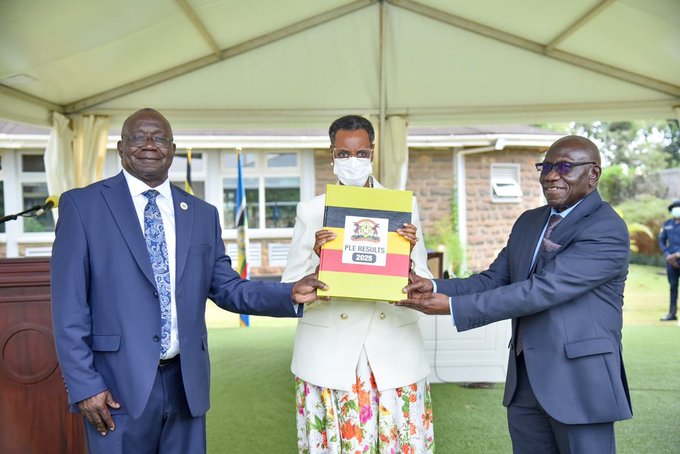

Kampala, January 30, 2026 — As results of the 2025 Primary Leaving Examination (PLE) are released, government has reaffirmed that education progression in Uganda is no longer limited to the traditional O-Level academic route. Through expanded secondary school infrastructure and a strengthened technical and vocational education system, learners completing Primary Seven now have multiple, flexible pathways to continue their education and skills development
Speaking at the release of the results at State House, Nakasero, the First Lady and Minister of Education and Sports, Hon. Janet K. Museveni, emphasized that the education system is deliberately being redesigned to accommodate learners with different talents, interests, and abilities.

With over 817,000 candidates registered for PLE in 2025, and more than 807,000 sitting the examination, transition beyond primary education remains a key policy priority. To address this, government has invested heavily in expanding access to secondary education through the construction of seed secondary schools, particularly in underserved communities.
Since 2019, government targeted the construction of 259 new seed secondary schools under the Uganda Intergovernmental Fiscal Transfers (UgIFT) Programme. To date, 204 schools have been completed and operationalized, while the remaining 55 are at various stages of construction
These schools have significantly increased the country’s capacity to absorb learners transitioning from primary education to O-Level, easing pressure on existing schools and reducing long travel distances for students in rural areas.
Beyond the academic pathway, the enactment of the Technical and Vocational Education and Training (TVET) Act 2025 marks a major shift in Uganda’s education landscape. The law formally establishes a parallel technical education system regulated by the TVET Council, existing alongside general education
Under this framework, learners who complete Primary Seven can enroll in community polytechnics, where they undertake a three-year skills-based training programme. Upon completion, graduates are awarded a Community Polytechnic Certificate, which is recognized as equivalent to O-Level education.
Government currently operates 42 community polytechnics, complemented by about 100 privately owned institutions, significantly widening access to vocational training across the country.
The expanded TVET pathway is aimed at equipping young people with practical, employable skills, supporting Uganda’s broader goal of socio-economic transformation. By providing early access to vocational education, government seeks to reduce youth unemployment, promote self-employment, and align education outcomes with labour market needs.
This approach also recognizes that not all learners thrive in purely academic settings, and that technical skills are equally valuable for national development.
For learners who may not immediately transition to secondary school or vocational training, government has encouraged them to repeat Primary Seven, enabling them to obtain the End of Primary Education Cycle Certificate. This certificate serves as evidence of foundational competencies required for further education or training
The new direction underscores a broader shift in thinking about education from an exam-driven system to one that values skills, competence, and lifelong learning. As UNEB continues to emphasize competency-based assessment at primary level, post-PLE pathways are increasingly aligned to prepare learners for real-world problem solving and productivity.
With expanded secondary schools, a legally anchored TVET system, and growing community polytechnic infrastructure, government says every PLE graduate has a place to go whether in the classroom, workshop, or training centre.