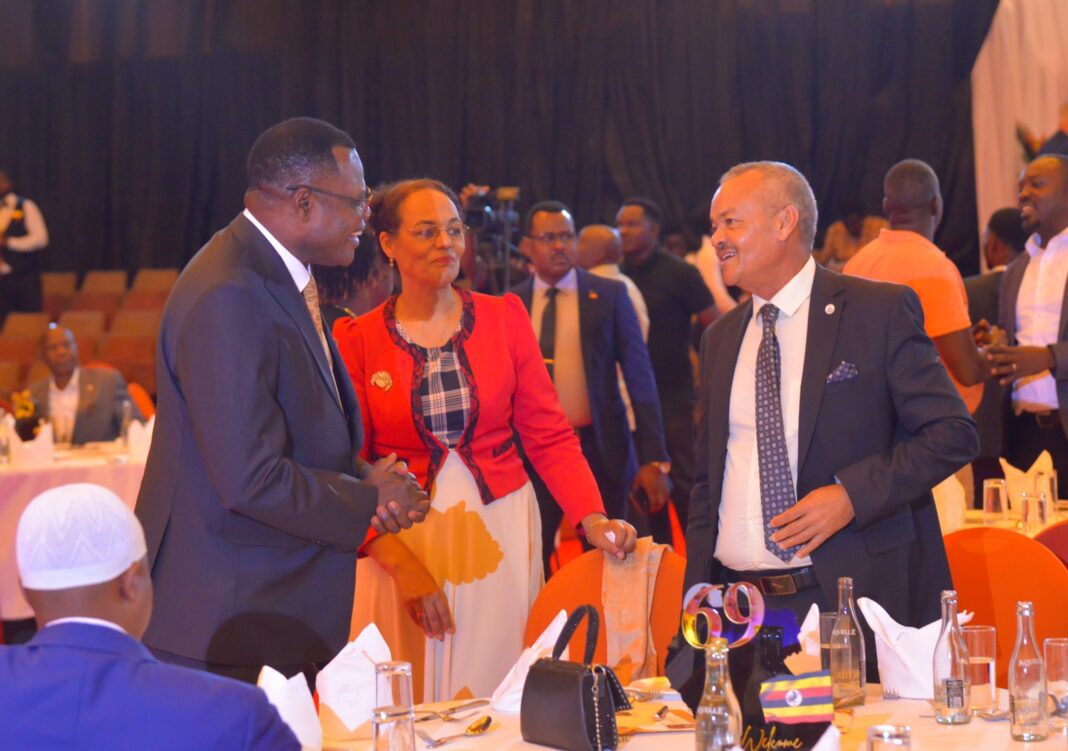

In a grand literary unveiling that captured the essence of Uganda’s modern history, Ambassador Dickson Ogwang Okul launched his latest work, “UGANDA SINCE 1986: The Socio-Economic Transformation Journey of Uganda Through the Eyes of a Foreign Service Officer,” on November 28, 2025.
Ambassador Dickson Ogwang Okul’s newly published book, Uganda Since 1986; the socio-economic transformation journey of Uganda through the eyes of a foreign service officer, offers an analytical account of Uganda’s post-1986 transformation, blending history, public policy, diplomacy and personal experience into a single national narrative.
Written from the vantage point of a seasoned Foreign Service Officer, the book examines Uganda’s recovery from state collapse to relative stability under the National Resistance Movement (NRM) government. Ogwang situates his analysis within lived institutional memory, drawing on his experience as a lawyer, diplomat and participant in state processes to interpret how security, governance and economic policy intersect in shaping national outcomes.
Launched recently during a ceremony held at Serena Hotel, Kampala and was presided over by the Chief of Defence Forces-CDF, Gen. Muhoozi Kainerugaba represented by Brigadier Gen. Paddy Ankunda and several distinguished gallery of high-ranking government officials, senior diplomats, and technocrats, the event underscored the book’s status as an indispensable national reference text. The book opens by establishing what Amb Ogwang describes as the baseline of collapse before 1986.

He reconstructs a period marked by economic disintegration, institutional paralysis and insecurity, when key export sectors had collapsed, infrastructure lay in ruin and public confidence in the state had eroded.


By deliberately confronting this era without nostalgia or sentimentality, Ogwang provides the context necessary to understand the scale of reconstruction that followed.
One of the book’s most compelling features is its elevated prose. Ogwang uses the metaphor of an “orchestra” to describe governance, where the Executive, Judiciary, Legislature, and security agencies, Ministry of Foriegn Affairs and Ugandan Missions abroad play interdependent instruments.

From this foundation, the book advances a phased account of Uganda’s renewal. Ogwang organizes the post-1986 period into interconnected stages: stabilization and recovery, expansion and diversification, value addition and industrialization, and the current shift toward a knowledge- and innovation-based economy.
This framework allows the author to present Uganda’s development not as isolated policy interventions, but as a sequenced national strategy shaped by evolving priorities and constraints.

A central argument running through the book is that peace and security are not abstract ideals but practical economic enablers.
Ogwang contends that the restoration of security after 1986 was the decisive condition that allowed markets to function, institutions to recover and investor confidence to return.

He links the expansion of infrastructure; roads, energy projects and industrial parks to what he terms the peace dividend, arguing that physical infrastructure represents the tangible conversion of stability into economic opportunity.
Equally prominent is Ogwang’s emphasis on human capital development where he highlights investments in education and healthcare as deliberate policy choices aimed at transforming peace into long-term societal capacity.
Programs such as Universal Primary Education and health-sector reforms are framed as foundational to Uganda’s social mobility and productivity, with effects that extend beyond any single administration.

One of the book’s more distinctive contributions lies in its treatment of diplomacy.
Amb Ogwang challenges traditional views of foreign ministries as administrative cost centers, advancing instead a model of economic and commercial diplomacy. Drawing on his experience in Uganda’s missions abroad, he illustrates how diplomats have acted as investment promoters, trade facilitators and national image managers. In this framing, diplomacy becomes a productive instrument of development, directly linked to employment creation, export growth and technology transfer.
The memoir element of the book adds a personal dimension to the analysis.
Ogwang interweaves national developments with recollections from his upbringing in Lango, his legal training and diplomatic postings, including service in Washington, D.C., and Sudan. This approach humanizes policy debates, translating macroeconomic reforms and institutional change into lived experience.

Stylistically, Uganda Since 1986 is marked by elevated diction and metaphor-rich prose. Amb Ogwang employs recurring imagery such as the orchestra of the state to explain governance as a coordinated effort among institutions, with leadership providing direction and tempo rather than isolated action. While openly sympathetic to the NRM’s ideological foundations, the book avoids overt partisanship, grounding its assessments in outcomes such as restored security, rebuilt infrastructure and institutional continuity.
He addresses enduring challenges including corruption, inequality, high production costs and governance inefficiencies, warning that these bottlenecks could undermine past gains if left unresolved. His discussion of public debt and infrastructure financing reflects an awareness of the need for balance between ambitious development and fiscal sustainability.

The book’s central themes align closely with the NRM’s emphasis on protecting and consolidating post-1986 achievements, framing Uganda’s progress as hard-won gains requiring stewardship rather than complacency.
Ultimately, Uganda Since 1986 positions itself as both a historical account and a policy reflection.
It serves as a reference for policymakers, diplomats, scholars and citizens seeking to understand how Uganda navigated recovery and reform.
By combining institutional insight with narrative depth, Ambassador Ogwang Okul offers a perspective that underscores continuity, sequencing and long-term vision as central to national transformation.

A highlight of the launch was Amb. Elly Kamahungye, representing the Permanent Secretary of Foreign Affairs, who emphasized that Uganda Since 1986 should serve as a nexus to the Foreign Service Policy Document for every Foreign Service Officer. This endorsement underscores the book’s practical value as a guide for understanding Uganda’s foreign policy, diplomatic priorities, and statecraft. For diplomats and policymakers, the text becomes a reference point for navigating Uganda’s international engagements and projecting its development story abroad.
Ambassador Dickson Ogwang Okul is a Ugandan patriot whose career blends law, military discipline and diplomacy. A lawyer and seasoned Foreign Service Officer, he rose from Public Prosecutor to a key national policy thinker, drawing on Armed Forces experience to link security with economic development. He played a significant role in pacifying Northern Uganda during the LRA insurgency and later served as Special Envoy to the United States, promoting recovery and reintegration. Beyond postings in Washington and Khartoum, he is a thoughtful author who documents Uganda’s transformation, guided by faith, integrity and a commitment to national unity.
Uganda Since 1986, authored by Ambassador Ogwang Okul, offers a compelling chronicle of Uganda’s socio-political and economic transformation under the stewardship of President Yoweri Kaguta Museveni. More than a mere historical account, the book positions itself as both a tribute and analytical reflection on the nation’s journey from turmoil to relative stability over nearly four decades.

Ambassador Okul, a seasoned diplomat and political analyst, organizes the narrative to provide a panoramic view of Uganda’s metamorphosis. The book is structured thematically, covering governance, security, economic policies, social programs, and regional diplomacy. Throughout, the author examines how the National Resistance Movement (NRM) statecraft shaped Uganda’s modern identity, often framing Museveni’s leadership as the driving force behind sustained national resilience.
A notable strength of the book is its detailed exploration of Uganda’s post-1986 recovery.
Currently working on his next book titled; The INTEGRITY MANDATE: Restoring Ethical Standards in Uganda, Ambassador Dickson Ogwang Okul has proven to be a “policy brain of ministerial proportions,” hiding in plain sight. He does not merely shout slogans, He documents outcomes with the precision of a practitioner who has actually done the work. This is a thinker worth listening to and a patriot worth deploying in the continued architecture of modern state transformation.
Uganda Since 1986 is a must-read for every citizen, diplomat, and policymaker who wishes to understand the soul of the New Uganda.